TIRA × Sol de Janeiro: How a Mumbai Street Became the Launchpad for a Global Beauty Brand
The launch of Sol de Janeiro on TIRA Beauty in Mumbai highlights a broader shift in how global beauty brands are entering India, prioritizing culturally contextual, experience-led campaigns over traditional retail announcements.
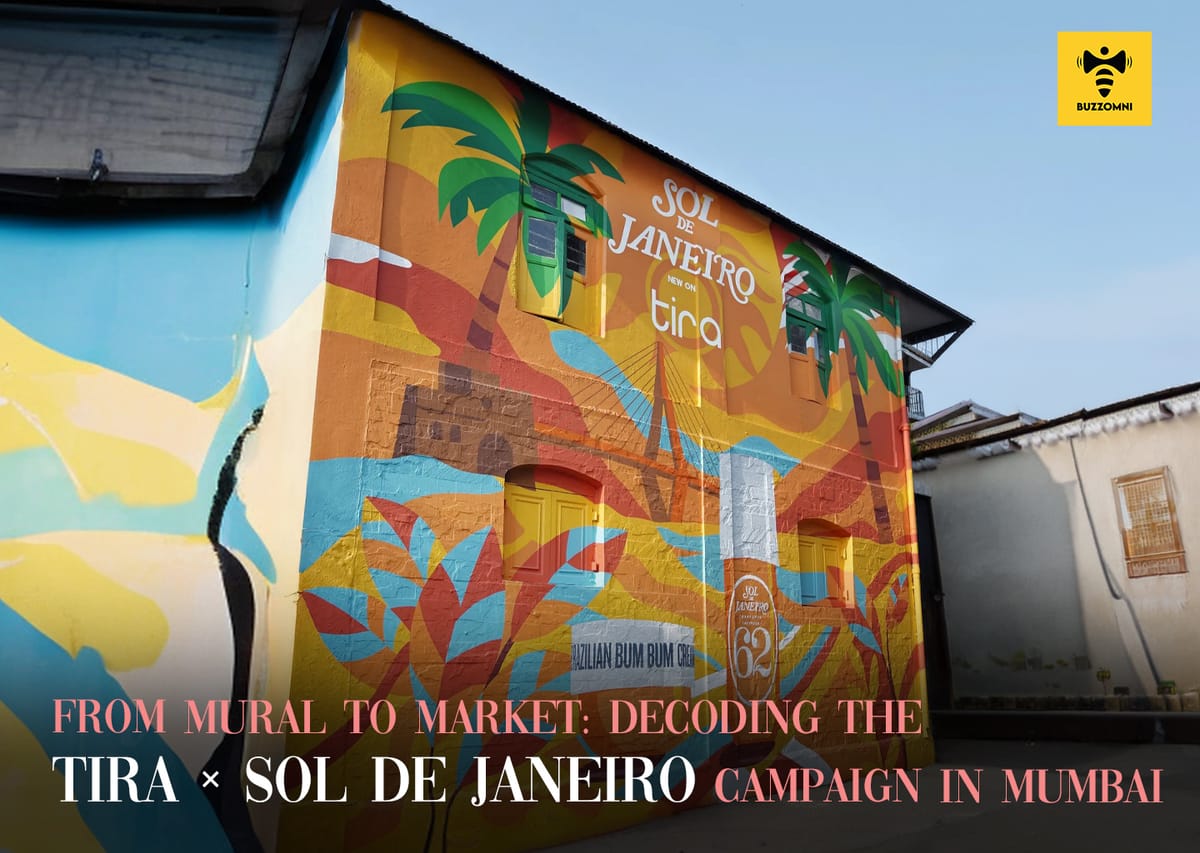
Table of Contents
- Introduction
- Why Chapel Road?
- The Mural as a Marketing Medium
- Creator Participation as Amplification Strategy
- Product Contextualisation in Public Space
- Extending the Activation Beyond the Wall
- What This Campaign Signals About Beauty Marketing in India
- Strategic Implications for Retail Platforms Like TIRA
- Conclusion
Why Chapel Road?
The recent launch of Sol de Janeiro on TIRA Beauty in Mumbai demonstrates how global beauty brands are entering the Indian market through culturally contextual, experience-led campaigns rather than conventional retail announcements.
Instead of relying solely on in-store promotions or digital advertising, the campaign centered around a public mural activation in Bandra’s Chapel Road, a location known for its vibrant street art culture. The initiative provides a useful case study in experiential marketing, creator collaboration, and hyperlocal storytelling.
Why Chapel Road?
Chapel Road in Bandra has long been associated with independent art, youth culture, and social-media-friendly backdrops. By selecting this site, the campaign leveraged:
- An organically high-footfall cultural zone
- A pre-existing association with visual storytelling
- Strong Instagram visibility due to the area’s popularity among creators
Rather than introducing a brand into a sterile commercial environment, the activation embedded it within a space already aligned with creativity and self-expression.
The Mural as a Marketing Medium
At the core of the campaign was a large-scale mural developed in collaboration with a local street art collective. The artwork drew visual inspiration from Sol de Janeiro’s Brazilian identity — bright hues, sun motifs, and tropical references — while being adapted to Mumbai’s urban aesthetic.
From a marketing perspective, murals function differently from billboards:
- They are perceived as cultural contributions rather than advertisements
- They encourage dwell time and photography
- They organically generate user-generated content
In this case, the mural was not just a static installation. It was executed as a live art activity, with invited creators participating in the painting process. This approach shifted the narrative from “brand display” to “brand co-creation.”
Creator Participation as Amplification Strategy
A key dimension of the activation was creator involvement. Rather than hosting a traditional press conference or influencer brunch in isolation, the brand integrated creators into the experiential element itself.
This resulted in:
- Real-time documentation of the mural’s creation
- Behind-the-scenes storytelling
- Organic social distribution across multiple accounts
The amplification model here is notable. Instead of paid amplification driving traffic to a central asset, distributed storytelling extended the lifespan of the physical installation. The wall became both a content generator and a backdrop for ongoing engagement.
For brands entering India’s competitive beauty landscape, this format reflects a broader shift: community-led visibility over one-directional advertising.
Product Contextualisation in Public Space
While the campaign centered on art, product visibility was integrated within the mural’s visual narrative. Hero products such as the Brazilian Bum Bum Cream and the Cheirosa 62 fragrance mist were illustrated in stylised formats.
Importantly, the products were not presented in overt retail framing. Instead, they were incorporated into a larger visual theme of warmth, vibrancy, and sensory indulgence.
This illustrates a strategic move away from transactional messaging (“now available”) toward atmospheric positioning (“this is what the brand feels like”).
In a market like Mumbai — where beauty consumption intersects with aspirational lifestyle cues — contextual storytelling can sometimes outperform direct call-to-action campaigns in early launch stages.
Extending the Activation Beyond the Wall
Following the mural reveal, a curated gathering was hosted nearby for invited creators. The experience included product trials and thematic elements consistent with the brand’s Brazilian aesthetic.
While such gatherings are common in beauty launches, their effectiveness increases when anchored to a larger public-facing moment. In this case, the event functioned as an extension rather than the primary activation.
This layered structure — public art + creator participation + curated engagement — allowed the campaign to operate across three levels:
- Public visibility
- Digital storytelling
- Influencer relationship-building
The integration of these layers is what differentiates it from a standard influencer-led product seeding effort.
What This Campaign Signals About Beauty Marketing in India
The TIRA × Sol de Janeiro campaign reflects several broader industry shifts:
1. Experiential Over Static
Consumers increasingly respond to experiences that feel participatory rather than imposed. Live murals and collaborative art installations offer immersion that traditional OOH formats cannot.
2. Cultural Anchoring
International brands are localising entry strategies by embedding themselves in culturally significant urban spaces rather than relying solely on global brand equity.
3. Social-First Physical Activations
Physical campaigns are increasingly designed with digital capture in mind. Every angle, colour choice, and interaction point serves dual purposes: in-person engagement and social media distribution.
4. Community Integration
By collaborating with local artists, the campaign avoided appearing externally imposed. This is particularly important when global brands enter culturally rich neighbourhoods.
Strategic Implications for Retail Platforms Like TIRA
For TIRA Beauty, the campaign also reinforces its positioning as more than a distribution platform. By facilitating experiential launches, the retailer strengthens its identity as a curator of global beauty experiences for Indian consumers.
In a competitive beauty retail ecosystem, differentiated launch formats can influence both brand perception and consumer recall.
Conclusion
The TIRA × Sol de Janeiro activation in Mumbai demonstrates how launch strategies are evolving within the beauty sector. By using public art as a narrative device, integrating creators into the execution process, and blending offline visibility with digital amplification, the campaign moved beyond a traditional product introduction.
Rather than focusing purely on product claims, it emphasised atmosphere, community, and place — elements increasingly central to how modern brands establish presence in culturally dynamic cities like Mumbai.