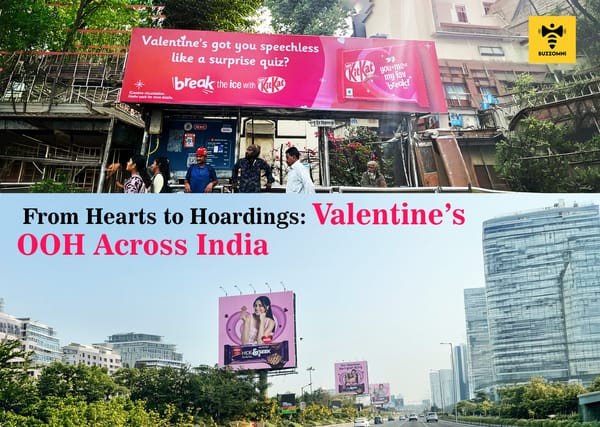
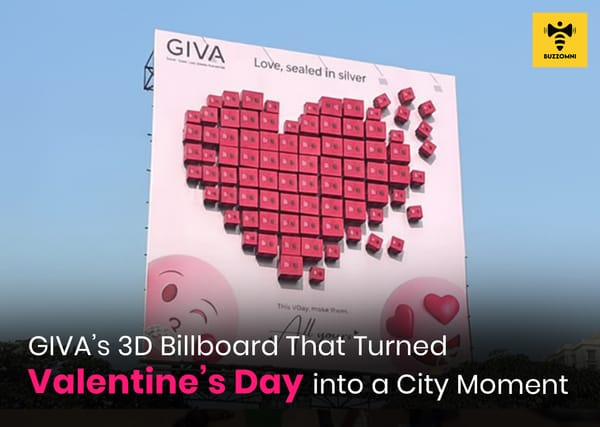
OOH in Motion: February 2026 Trends Shaping the Streets
OOH in February 2026 is shifting toward moment-led creatives, retail integration, mobility-based planning, and measurable transit media. Here’s how outdoor advertising is becoming smarter, closer to conversion, and performance-driven.
Table of Contents
- Introduction
- Moment-Led OOH
- Retail OOH: The Last-Mile Influencer
- Movement-Based Media Planning
- Measurable Streets
- The Bigger Picture
Introduction
February reflects a clear evolution in how brands are approaching out-of-home media. The focus is no longer just scale and static visibility. It is about contextual intelligence, proximity to purchase, movement-led strategy, and measurable performance.
Here are the four OOH trends shaping the month.
Moment-Led OOH
OOH is rapidly evolving from location-based planning to moment-based communication. Creatives are now adapting to real-time triggers such as weather shifts, traffic congestion, live sports victories, cultural events, and even time-of-day behavior patterns.
This shift is being powered largely by digital screens and smarter content management systems that allow for dynamic creative optimization. Instead of displaying a single static message for weeks, brands can rotate contextual messaging that aligns with what audiences are experiencing in that exact moment.
For example, a beverage brand can push a heat-led creative during peak afternoon temperatures and switch to a commute-themed message during evening rush hour. The objective is simple: relevance increases recall. When messaging feels timely and situational, it stands out in a cluttered environment.
Moment-led OOH represents a strategic upgrade. It shifts outdoor media from passive exposure to contextual engagement.
Retail OOH: The Last-Mile Influencer
Another clear February trend is the rise of retail-integrated OOH. In-store and mall screens are increasingly influencing purchase decisions closer to the checkout counter.
Traditional OOH was often considered top-of-funnel media. Its role was to build awareness and brand familiarity. Today, that definition is expanding. With digital placements inside malls, supermarkets, and large-format retail stores, OOH now operates within high-intent environments.
Consumers in retail spaces are already in decision-making mode. Strategic screen placements near category aisles, escalators, food courts, or billing counters allow brands to reinforce messaging at a critical moment. This proximity can influence impulse purchases, brand switching, and promotional uptake.
Retail OOH bridges the gap between visibility and conversion. It integrates awareness with action, making outdoor media a more commercially aligned channel.
Movement-Based Media Planning
Transit media is undergoing a structural shift in how it is planned. Campaigns are now being designed around routes, traffic density, and dwell time instead of relying solely on static demographic targeting.
Urban mobility data has become a central input in campaign strategy. High-traffic corridors, peak-hour congestion points, IT parks, corporate clusters, and residential commute patterns are guiding fleet allocation and route mapping.
This approach recognizes that cities are dynamic systems. People do not remain in one fixed location throughout the day. They move through predictable routes, often spending extended time in traffic or at transit junctions. Those dwell moments create repeated exposure opportunities.
Movement-based planning allows brands to align visibility with real behavioral flow. Rather than asking only “Who is the audience?”, marketers are also asking “How does the audience move?”
This shift enhances frequency, repetition, and contextual relevance, especially in high-density urban environments.
Measurable Streets
Perhaps the most important evolution in February is the growing emphasis on accountability. Transit OOH is becoming performance-driven through GPS tracking, QR integrations, scan data, and impression modeling.
Historically, OOH measurement relied on estimated reach and traffic studies. While those models still exist, new tools are strengthening attribution conversations. Route tracking ensures fleet compliance. QR codes enable engagement tracking. Impression modeling improves exposure estimates. Geo-verification adds transparency.
These capabilities are helping brands move beyond the perception that OOH is difficult to measure. Performance data now supports ROI discussions with greater clarity.
As marketing budgets become more scrutinized, the ability to quantify impact is no longer optional. Measurable transit and street-level media are reinforcing OOH’s role as a credible, accountable channel within integrated media plans.
The Bigger Picture
Taken together, February’s trends reveal a clear direction for the industry:
- Context is replacing static placement
- Proximity is strengthening purchase influence
- Movement data is redefining media planning
- Measurement is reinforcing credibility
OOH is not just expanding in format or inventory. It is evolving strategically. The medium is becoming smarter in execution, closer to conversion, aligned with real urban behavior, and more accountable in performance.
For brands, this signals opportunity. The streets are no longer just visible. They are intelligent, dynamic, and measurable.