How Smart Cities Are Redefining Outdoor Advertising Spaces
As cities get smarter, outdoor advertising is evolving beyond static billboards. From real-time data to interactive urban screens, smart cities are reshaping how brands connect with audiences in public spaces.
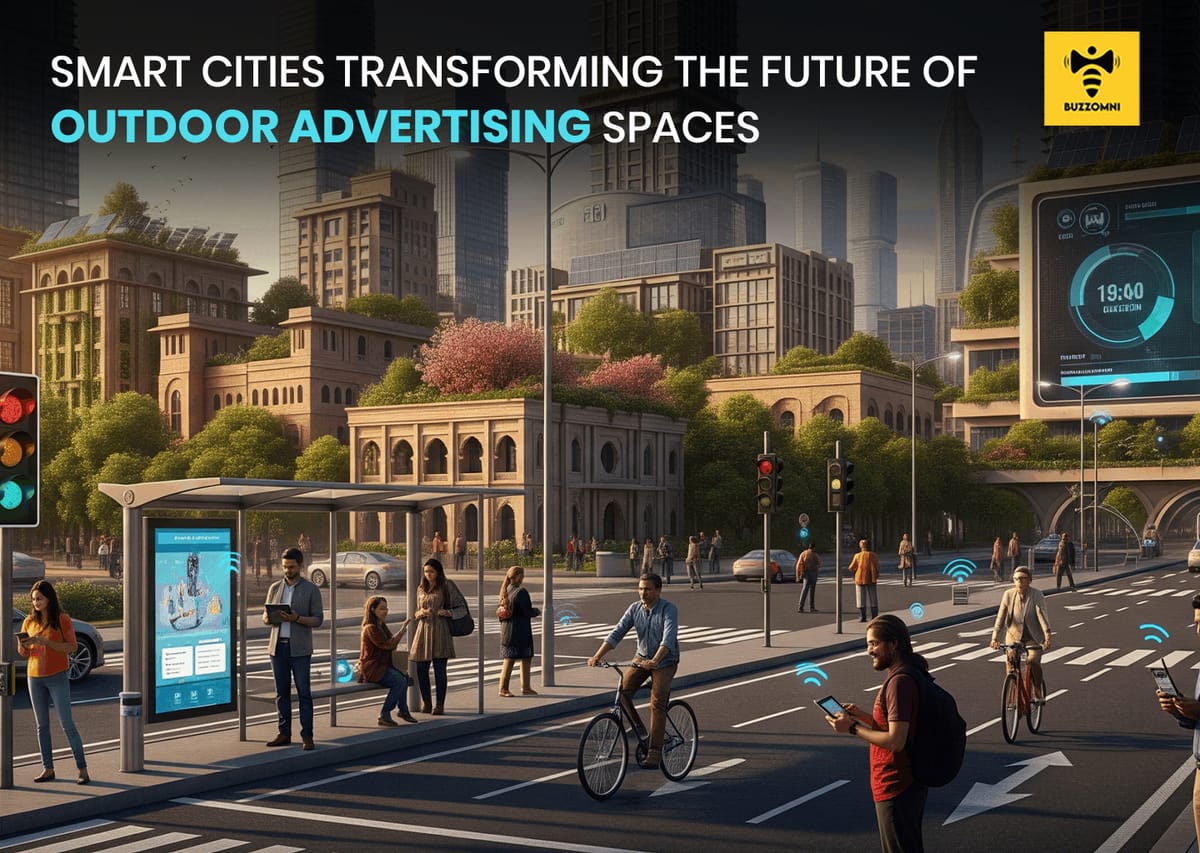
Table of Contents
- Introduction
- What Defines a Smart City?
- The Shift From Static to Dynamic Advertising
- Data-Driven Targeting in Public Spaces
- Interactive and Immersive Engagement
- Benefits for Cities, Brands, and Consumers
- Privacy and Ethical Considerations
- The Future of Outdoor Advertising in Smart Cities
Introduction
Outdoor advertising has always served as a bridge between brands and consumers in shared public environments. From static billboards to neon signs, marketers have historically pursued high-traffic locations to maximise visibility.
Today, however, the rise of smart cities—urban landscapes embedded with digital infrastructure, data networks, and intelligent systems—is fundamentally reshaping outdoor advertising. In this new paradigm, advertisers are no longer restricted to fixed physical formats or passive messaging; they are engaging audiences in real time with context-aware, interactive, and highly personalised experiences.
What Defines a Smart City?
A smart city uses information and communication technologies (ICT), the Internet of Things (IoT), artificial intelligence, and data analytics to enhance the efficiency of urban services and improve the quality of life. Sensors, cameras, connected devices, and data platforms continuously collect and process information about how people move, interact, and engage in public spaces. This data ecosystem enables city managers to optimise traffic flow, reduce energy consumption, improve public safety, and support smarter infrastructure planning.
It also creates fertile ground for next-generation advertising.
The Shift From Static to Dynamic Advertising
Traditional outdoor advertising—static billboards, posters, and transit ads—offers one-size-fits-all messaging that cannot adapt to changing contexts. Smart city technologies enable dynamic outdoor advertising, where displays adjust content in real time based on environmental cues such as:
- Foot traffic density
- Time of day
- Weather conditions
- Demographic patterns
- Local events
For example, a smart billboard near a transit hub can display coffee promotions during morning rush hour, switch to restaurant offers at lunchtime, and pivot again to nightlife events after work hours. In adverse weather, screens can promote relevant products (e.g., umbrellas when rain is imminent). This adaptability increases relevance, recall, and engagement while reducing wasted impressions.
Data-Driven Targeting in Public Spaces
Smart cities provide access to aggregated, anonymous data about urban movement patterns. Advertisers can use this information to understand:
- Peak pedestrian and vehicle flows
- Popular city corridors and gathering spots
- Behavioural trends across neighbourhoods
- Pathways commuters take throughout the day
With these insights, brands can strategically place digital ads where their target audience is most likely to engage. This moves outdoor advertising closer to the precision of digital channels while leveraging the scale of physical spaces.
Interactive and Immersive Engagement
Smart outdoor advertising isn’t limited to screens. Interactive installations, augmented reality (AR), and sensor-driven experiences turn passive viewers into active participants. Examples include:
- AR overlays triggered by mobile devices
- Gesture-controlled displays that respond to movement
- QR codes that deliver instant promotional offers
- Social media integrations for live interactions
These immersive formats drive deeper engagement and create memorable brand interactions within the urban environment.
Benefits for Cities, Brands, and Consumers
The convergence of smart cities and outdoor advertising delivers value on multiple fronts:
For Cities
- Additional revenue from dynamic ad placements
- Enhanced public spaces with digital utility and information
- Data-informed city planning through aggregated insights
For Brands & Advertisers
- Real-time contextual targeting
- Performance measurement through analytics (impressions, interactions, dwell time)
- Flexibility to update messaging without physical replacement
For Consumers
- More relevant, useful content in public settings
- Reduced ad clutter from poorly timed or irrelevant messages
- Interactive experiences that enhance urban life
Privacy and Ethical Considerations
With increased data use comes heightened responsibility. Smart outdoor advertising must comply with privacy regulations, including:
- Transparent data collection practices
- Anonymisation of personal information
- Avoidance of intrusive tracking
- Clear opt-in/opt-out mechanisms
Balancing innovation with ethical guidelines ensures public trust and sustainable adoption.
The Future of Outdoor Advertising in Smart Cities
Smart cities are still evolving, and outdoor advertising is expanding with them. Future possibilities include AI-powered predictive messaging, hyper-personalised visuals based on permissioned user preferences, and full integration with urban mobility platforms.
For brands seeking to stand out in a crowded market, smart city advertising offers a frontier where digital precision and physical presence combine to reach audiences in the right place, at the right time, with the right message.